Know when something changes
The difference between finding out from your data and finding out from a complaint.
Told, on the channel you actually watch
Alarms are set on any channel and delivered by web, email, SMS or voice. Schedules decide who is notified at what time of day, so an overnight alarm reaches whoever is on duty rather than an inbox nobody is reading.
Alarms and notifications are two severity levels, not two words for the same thing. They are configured identically, but a triggered alarm turns the site red on the map and says “Alarm”, while a notification turns it orange and says “Notification”. So you can put a notification at the level where someone should start paying attention and an alarm at the level where someone has to act — on the same site, on the same channel.
Dwell time stops the system firing repeatedly for the same event, which is what makes alarms irritating. Acknowledgement records that a notification has been received. Set up properly, the two together are why staff act on an alarm rather than dismissing it as another false one.
Users set and acknowledge notifications themselves over a secure connection, without needing to involve IT.
- Web, email, SMS and voice delivery
- Two severity levels — notification (orange) and alarm (red) — on the same site
- Schedules, so the right person is told at the right hour
- Dwell times to suppress transient spikes
- Acknowledgment and alarm history — who picked it up, and when
- End-of-event messages as well as start, so you know when it cleared
- Set and managed by users, not by IT
The alarm that needs two channels to agree
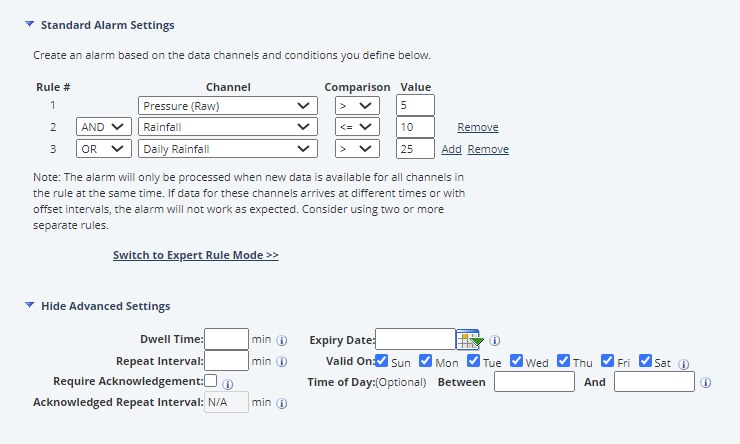
A rule compares a channel against a value using any of six operators — greater than, less than, equal, greater or equal, less or equal, or not equal. That covers the simple case.
Rules can be built on multiple channels and can include calculations, which reduces false alarms.
The clearest example is one of ours: level above 4 feet AND velocity below 1 foot per second. Either alone is unremarkable — levels fluctuate, and slow flow at low level is normal. Together they suggest something downstream is blocking the pipe. A single-threshold alarm cannot express that; this one can.
Alarm and notification settings can use logical operators across multiple sites and channels, so a specific set of criteria must be met before anything triggers.
- Six comparison operators on any channel
- Combine rules with AND and OR into one trigger
- Multi-channel conditions — blockage, backup, process faults
- Late data alarms for when a site stops reporting at all
The information that matters, at the site
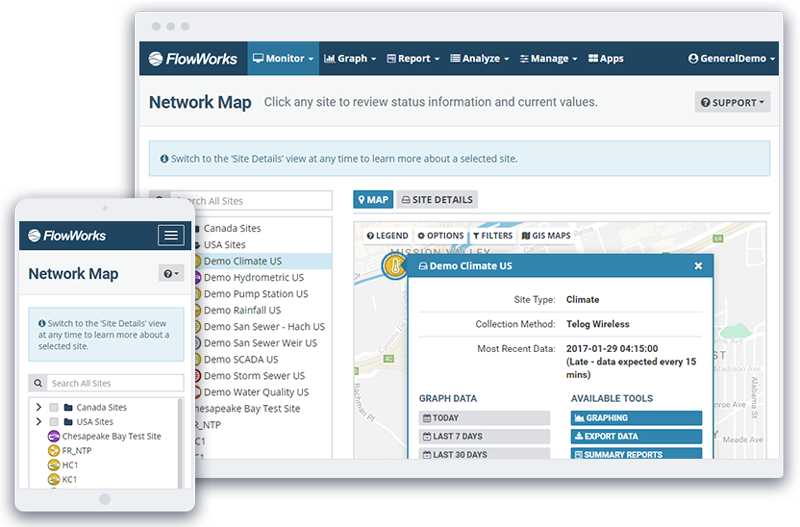
Field staff can receive and respond to alarms and notifications through the mobile app. From the app they can see alarm history and drill into the detail of what is happening at a site.
For field staff responding to an alarm, the recent trend and the last photo are usually worth more than the threshold that was crossed.
- Alarm state and history on a phone
- Site details and recent readings at the site
- Photo channels for visual confirmation before a truck roll
Set an alarm you wish you had had
Set up a live connection to a sensor and set an alarm, to see how it works.